Ap 2 Electrostatics Frq Draw Electric Field Lines
Ap 2 Electrostatics Frq Draw Electric Field Lines
Unit Overview🧭
Welcome to Unit 5! Here we'll take a look at how magnets work, as well as investigate the relationship between electricity and magnetism. This topic is the foundation of most of our modern world. It allows us to create electricity, use electric motors, and makes speakers, computers, and cell phones all work. As far as the AP exam is concerned, this unit covers approximately 10% of the exam questions. If you'd like some practice problems, check out the AP Classroom Unit 5 Progress Check which has 35 MCQ and 2 FRQ for you to try
5.1 Electric Fields & Forces 🧙
This section builds on the concepts from Unit 3, specifically Coulomb's Law. I'm going to do a quick overview of it below, but if you want a more in depth look, please take a few minutes to refresh yourself with that material.
Resources:
Electrostatic Force & Coulomb's Law
Coulomb's Law describes the force of attraction (or repulsion) experienced between two charged point objects. Point charges simply mean that we can approximate the charges as acting from a single point. The equation for calculating electrostatic force is given below:

where q1 and q2 represent the two charges, r is the distance between the charges, and εo is the Permittivity of Free Space constant (which is given in your reference tables). Notice that if q1 and q2 are the same charge, we'll end up with a positive result. A positive Fe value leads to repulsion.
Physics Review Note: Electrostatic Force is a force! This means that we need to apply Newton's 3 Laws to the movement of charges too. One very common mistake is to forget that the two charged objects form a Newton's 3rd Law pair, the force between the two objects is equal in magnitude and opposite in direction.
Electric Fields
Every charged object has an electric field surrounding it, similar to how every object with mass has its own gravitational field. The more charge (or mass) there is, the stronger the field is. The only difference is that while a gravitational field must be attractive, an electric field can be either attractive or repulsive. By convention, we use the direction that a positive test charge will move to draw our electric fields.
Rules for Drawing:
-
Field lines are vectors and must be drawn with arrows.
-
Lines go away from a positive charge and towards a negative charge.
-
The strength of the field can be visually represented by the density of the field lines. Therefore field, lines must never touch or cross. This would represent an infinitely strong field.
Simple Fields 🌐
-
Point Charges
-
Notice the radial symmetry in the fields.
-
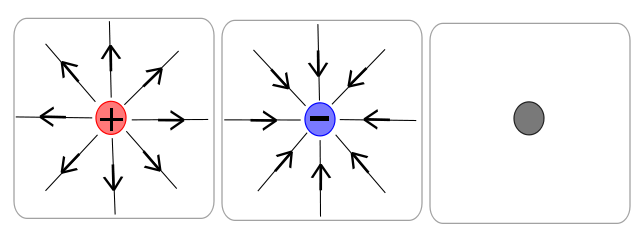
Image Courtesy of wikimedia
-
Two Point Charges
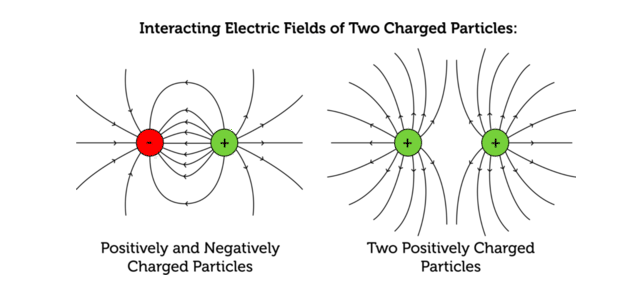
Image Courtesy of Ck12
-
Two Parallel Plates
-
Notice how the field is the same everywhere between the plates.
-
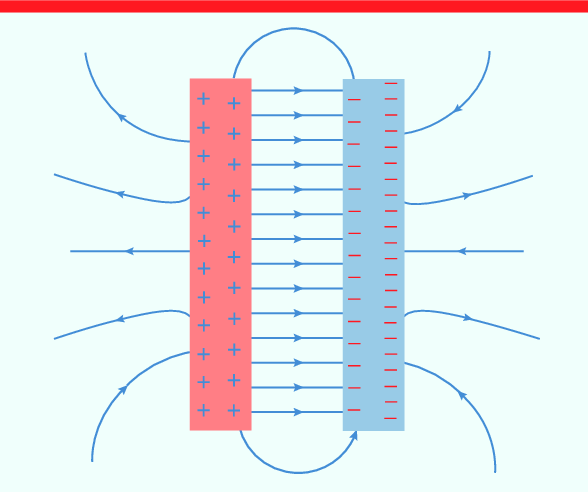
Image Courtesy of researchgate
Try using the PhET simulation below to create your own fields and notice how the field strength changes as a function of charge and distance.
Electric Field Strength
We've seen visually what electric fields look like. Now it's time to mathematically describe them.
The basic idea is to place a test charge at various locations in the field, measure the electrostatic force at that location, then calculate the field strength. The equation off of your reference tables for electric field strength is:

where Fe is the electrostatic force found by using Coulomb's Law, and q is the charge on the test charge used to measure the field.
We can also rearrange the equation to determine E in terms of the charge on the point charge Q.

Practice Questions:
-
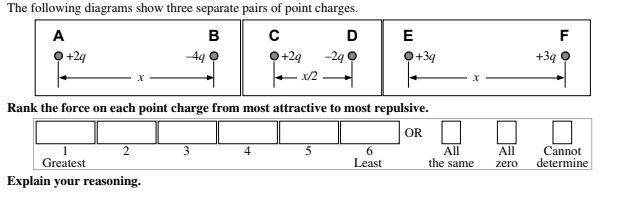
Image created by the author
Answer
C = D > A = B > E = F
Each pair of point charges must have an equal force on them (N3L). A&B and C&D have opposite charges so therefore must attract. E&F have the same charge and must be repelling. The magnitude of the force is directly proportional to the charges and inversely proportional to the square of the separation distance, so the shorter distance in C&D results in a larger force even though the charge in B has a greater magnitude.
A & B ⇒ Fe = -8 / x^2 (Attractive)
C & D ⇒ Fe = -4 / (x/2)^2 = -16/x^2 (Attractive)
E & F ⇒ Fe = 9/x^2 (Repulsive)
2.

Image Courtesy of collegeboard
a) What is the direction of the force on the test charge due to the two other charges?
b) If F is the magnitude of the force on the test charge due to only one of the particles, what is the net force acting on the test charge due to both of the charges?
Answer
a) The net force must be directed towards the bottom left corner of the page. The test charge and both Q charges are positive so they must repel. The test charge is repelled downwards and to the left.
b) The test charge experiences two forces, both of magnitude F repelling it downwards and to the left. Using the Pythagorean theorem we can determine the resulting net force

3.
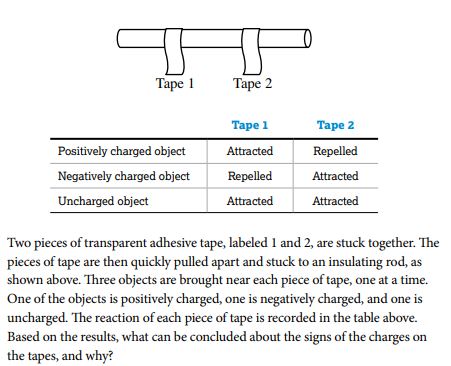
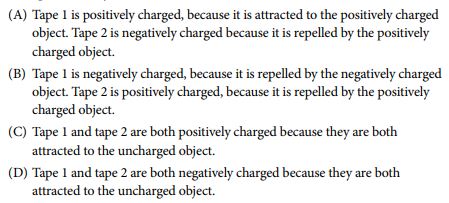
Image Courtesy of the AP Physics 2 Course & Exam Description
Answer
Choice B is correct.
Because both tape 1 and 2 attract an uncharged object, we know they both must have a net charge. Since like charges repel and opposites attract, Tape 1 must be negative and Tape 2 must be positively charged.
Ap 2 Electrostatics Frq Draw Electric Field Lines
Source: https://fiveable.me/ap-physics-2/unit-5/ap-physics-electric-fields/study-guide/DBJDysHHkjOAbV9uEqvO


Komentar
Posting Komentar